
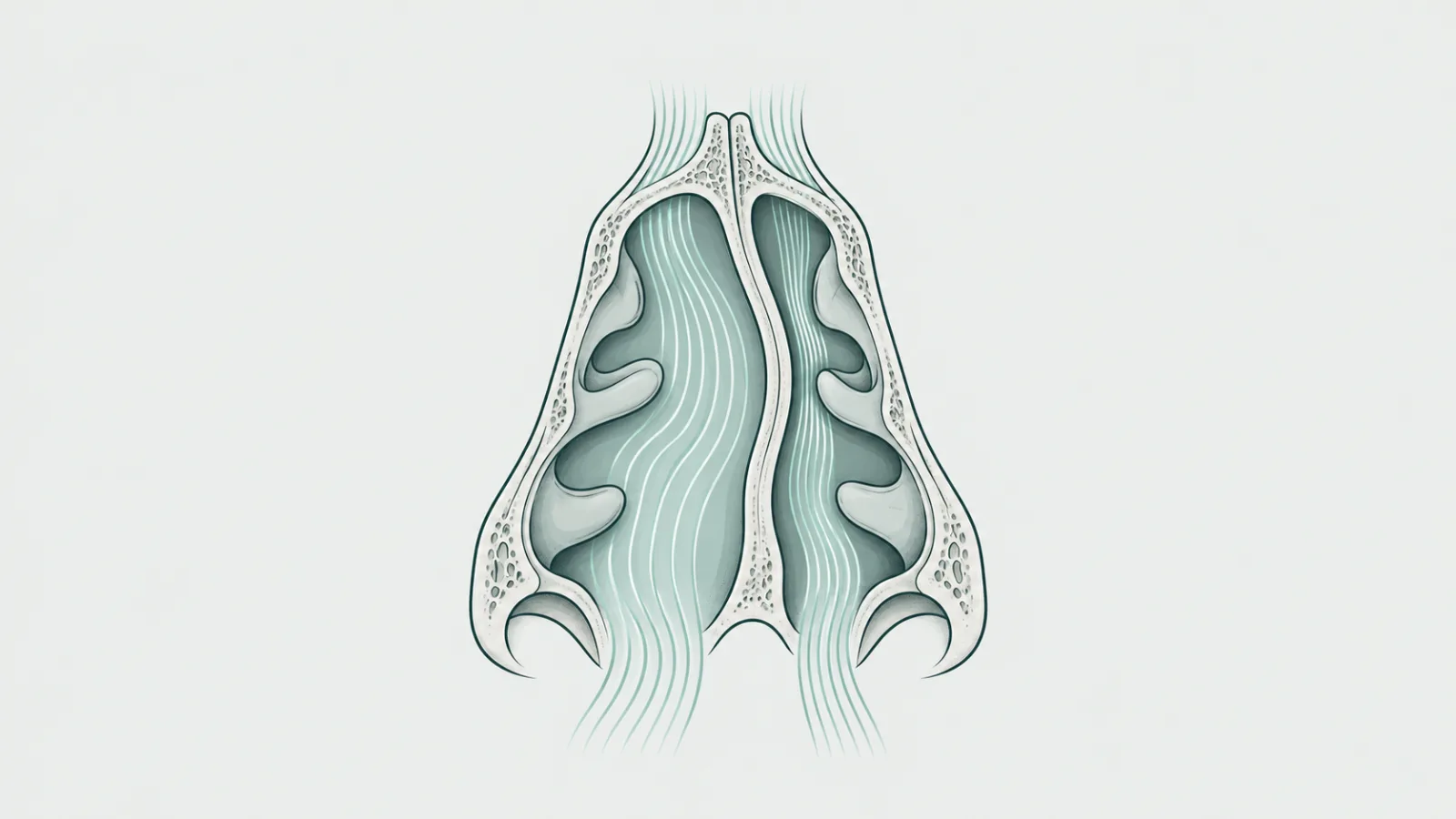
Short answer: A deviation of the wall inside the nose (deviated septum) is often not visible from the outside; it shows itself through a constantly blocked nose, mouth breathing, snoring and repeated sinusitis. Because the same symptoms can come from enlarged turbinates or allergy, the distinction is made at an ear, nose and throat consultation in which the inside of the nose is examined with an endoscope.
In everyday language, a “crooked nose” can mean two different things: a nose that looks bent from the outside, and a wall inside the nose (the septum) that is bent. In medicine, the second is called a deviated septum. An internal deviation may not be visible from the outside; it often shows itself through breathing problems.
What is a deviated septum?
The septum is the wall of cartilage and bone that divides the nasal cavity in two. Mild deviations are very common and cause no problems in most people. A deviation can be present from birth, develop during growth or result from a blow to the nose. Symptoms appear when the deviation markedly narrows the airflow.
Common symptoms
- A constant feeling of blockage on one or both sides of the nose
- Mouth breathing, especially during sleep
- Snoring and a dry mouth in the morning
- Difficulty breathing well through the nose during exercise
- Repeated episodes of sinusitis
- Repeated nosebleeds on the deviated side
Blockage that switches sides during the day or depending on which side you lie on is not always caused by a deviation; it can be due to the turbinates swelling and shrinking in turn, which is normal.
Other conditions that cause similar symptoms
The septum is not the only cause of a blocked nose. The same symptoms can come from other structures, and their treatment is different:
- Turbinate hypertrophy: enlargement of the turbinates on the side wall of the nose
- Allergic rhinitis: seasonal or year-round sneezing, runny nose and blockage
- Sinus conditions and nasal polyps
- In children, enlarged adenoids
That is why, before deciding on treatment, the real source of the blockage needs to be identified. A deviated septum and enlarged turbinates often occur together.
What happens at the consultation?
- You are asked how long the problem has lasted, which side is affected, about allergies and any previous injury to the nose.
- The inside of the nose is examined first with a light and then with a fine endoscope. This shows the deviation of the septum, the size of the turbinates and the back of the nose.
- If needed, a spray that temporarily shrinks the turbinates is applied and the examination is repeated; this shows how much of the blockage is structural.
- If sinus disease is suspected, a CT scan may be requested.
Treatment options
Nasal sprays and allergy treatment can ease symptoms by reducing the associated swelling and discharge, but they do not correct the structural deviation of the cartilage and bone. If the deviation causes marked symptoms, the solution is septoplasty, an operation done from inside the nose. If the turbinates are also enlarged, they can be reduced in the same operation.
If a change in the outward appearance of the nose is also wanted, septum correction can be planned together with rhinoplasty, as a septorhinoplasty.
When should I see a doctor?
If the blockage has lasted a long time, affects your sleep or daily life, if sinusitis keeps coming back, or if you need to use nasal sprays all the time, it is worth having the cause identified at an ear, nose and throat consultation.
Related articles
Sources
- Han JK et al. Clinical Consensus Statement: Septoplasty with or without Inferior Turbinate Reduction. Otolaryngology–Head and Neck Surgery, 2015.
- Seidman MD et al. Clinical Practice Guideline: Allergic Rhinitis. Otolaryngology–Head and Neck Surgery, 2015.
- Rosenfeld RM et al. Clinical Practice Guideline (Update): Adult Sinusitis. Otolaryngology–Head and Neck Surgery, 2015.
This article is for general information only. Diagnosis and treatment decisions are made by the doctor after a consultation; results of surgical procedures vary from person to person.
The information on this page is for general guidance only; diagnosis and treatment decisions are made by the doctor after a consultation. Results of surgical and interventional procedures vary from person to person.